Lets say we have a contacts app and one of the screens shows the contact’s phone number.
This file contains hidden or bidirectional Unicode text that may be interpreted or compiled differently than what appears below. To review, open the file in an editor that reveals hidden Unicode characters.
Learn more about bidirectional Unicode characters
The problem with that code is that we can easily end up with instances that contain invalid state:
A phone number screen with an empty phone number!
Approach #1:
One way to prevent it is to add some logic in the presentation layer:
Open the phone number screen only if the phone number is not empty
This file contains hidden or bidirectional Unicode text that may be interpreted or compiled differently than what appears below. To review, open the file in an editor that reveals hidden Unicode characters.
Learn more about bidirectional Unicode characters
Unfortunately this approach does not provide an actual solution but a patch. Our main goal is to have a PhoneNumberScreen that handles ONLY valid phone numbers.
Approach #2:
What we need is to move the necessary checks inside the PhoneNumberScreen class.
We could check the number’s validity on render and show some kind of message when there is no phone number.
This file contains hidden or bidirectional Unicode text that may be interpreted or compiled differently than what appears below. To review, open the file in an editor that reveals hidden Unicode characters.
Learn more about bidirectional Unicode characters
It is quite clear that this solution provides a bad UX. Why open a screen when the user cannot use it? Also, in any additional usage of phoneNumber inside the PhoneNumberScreen we need to make the same check as in render() and handle both of its states.
Approach #3:
What we really need is to make sure that if the screen is created, then it is certain that it has a valid phone number. There are two ways to achieve that. The first one is by checking upon creation that the phone number is valid and throw an exception if it is not.
This file contains hidden or bidirectional Unicode text that may be interpreted or compiled differently than what appears below. To review, open the file in an editor that reveals hidden Unicode characters.
Learn more about bidirectional Unicode characters
It works but we need to document it and add a try-catch wherever we create a screen instance.
The second one is by having a helper function that creates the screen only if the phone number is valid.
This file contains hidden or bidirectional Unicode text that may be interpreted or compiled differently than what appears below. To review, open the file in an editor that reveals hidden Unicode characters.
Learn more about bidirectional Unicode characters
This also works as expected but once again we need to document it and on top of that handle any null values returned by the helper function.
Nevertheless this solution seems fine and for a very small code base is quite acceptable. The problem is that it does not scale alongside the code base. Imagine how many helper functions we need to implement every time we have to use a phone number instance in our components if we want to keep them “clean”.
The actual problem
The actual problem lies in the PhoneNumber itself. It represents more than one states and each time we use an instance of it we must “dive” in its value and translate it to that state.
What we really need is a better representation of a valid and invalid phone number.
Final approach
This is where we use sealed classes and separate the two states:
This file contains hidden or bidirectional Unicode text that may be interpreted or compiled differently than what appears below. To review, open the file in an editor that reveals hidden Unicode characters.
Learn more about bidirectional Unicode characters
This way we accomplish our main goal: we change the PhoneNumberScreen to accept only instances of ValidPhoneNumber and can now be certain that the screen will be used only with valid data. The code is self documented and any further development in the screen class will not have to consider other states for the phone number:
This file contains hidden or bidirectional Unicode text that may be interpreted or compiled differently than what appears below. To review, open the file in an editor that reveals hidden Unicode characters.
Learn more about bidirectional Unicode characters
One big drawback of this change is that every usage of the PhoneNumber class has just broke (see: creation of Contact instances).
Fortunately there is a quick solution for that! Factory function:
A function that has the same name with the previously used class (PhoneNumber) and takes a single string parameter. If the parameter is not empty it returns a ValidPhoneNumber. In any other case it returns an InvalidPhoneNumber:
This file contains hidden or bidirectional Unicode text that may be interpreted or compiled differently than what appears below. To review, open the file in an editor that reveals hidden Unicode characters.
Learn more about bidirectional Unicode characters
The end result is almost the same as the starting point but this time we have clear states and components that can guarantee that they will not crash because of erroneous data:
This file contains hidden or bidirectional Unicode text that may be interpreted or compiled differently than what appears below. To review, open the file in an editor that reveals hidden Unicode characters.
Learn more about bidirectional Unicode characters
A small and simple example that shows one of the benefits of having domain objects.
Lets assume we need to make a request for some kind of a token and the flow for doing so goes like this:
Validate an email address
With the validated address validate a password
With both the validated values request for the token
The not so revealing way
This file contains hidden or bidirectional Unicode text that may be interpreted or compiled differently than what appears below. To review, open the file in an editor that reveals hidden Unicode characters.
Learn more about bidirectional Unicode characters
Q:Can the consumer of this API, without knowing the aforementioned flow, figure it out just by looking at the functions’ signatures?
A: I guess she could if the parameters’ names were like that. If not she needs to read the bodies of those functions to see that there is some kind of order that needs to be followed.
Q:Can the creator of this code be 100% certain that the functions will be used as expected and the passed parameters will be valid? For example, will requestToken always be called last and with valid addresses and passwords?
A: No! There is nothing that can guarantee that so, just to be safe, we check in every function that the provided values are valid and make the code flexible enough that, for example, each function could be used on its own. That will, potentially, lead to code duplication or unnecessary abstractions.
Q:What about errors and invalid values? Can the consumer of this API predict the code’s behavior on erroneous inputs without reading a documentation?
A: No. Just no.
The revealing way
First lets enrich our API with some, much needed, domain objects:
This file contains hidden or bidirectional Unicode text that may be interpreted or compiled differently than what appears below. To review, open the file in an editor that reveals hidden Unicode characters.
Learn more about bidirectional Unicode characters
Having those constructs we can change the functions and make them reveal both the order they can be used and their behavior:
This file contains hidden or bidirectional Unicode text that may be interpreted or compiled differently than what appears below. To review, open the file in an editor that reveals hidden Unicode characters.
Learn more about bidirectional Unicode characters
So lets pretend that we are the consumer of this API and all we have is the code.
Our main goal is to request for a token. By just looking at the functions’ signatures we see that there is a requestToken. Nice! Our task is half way done! What do we need for calling this function? A valid email address and a valid password. Ok. How do we get one of each?
Looking again at the signatures we see validateEmailAddress and validatePassword that return an EmailAddress and Password respectively. Lets check what those are. These are abstractions and each of them has been extended to a valid and an invalid state. The invalid one carries the error that occurred too! So, back to the functions.
We see that validating a password needs to be fed with a valid email address so we first need to call validateEmailAddress, then validatePassword and finally requestToken.
That’s it. We didn’t read the code of the functions and we didn’t have to worry about our inputs.
We have a task. A task can be unassigned OR it can be assigned either to a user OR a group.
First implementation: the ugly way
One way to implement this is by putting all the logic in the task:
This file contains hidden or bidirectional Unicode text that may be interpreted or compiled differently than what appears below. To review, open the file in an editor that reveals hidden Unicode characters.
Learn more about bidirectional Unicode characters
By default the task is unassigned and if we want an assigned task we provide a user or a group. The or factor is being enforced by a check in the constructor.
This
implementation not only relies on nulls to represent the business logic
but it also hides the logic from the developer who has to read the code
to understand how to create an assigned task.
The null checking comes also up when we want to figure out if and where a task is assigned which is tedious and can easily lead to bugs. As an example lets consider a simple function that prints the task’s assignment state:
This file contains hidden or bidirectional Unicode text that may be interpreted or compiled differently than what appears below. To review, open the file in an editor that reveals hidden Unicode characters.
Learn more about bidirectional Unicode characters
Finally two points that we should not neglect are readability and scalability. When using UglyTask if we want our code to be readable, in all cases, we have to pass the arguments by their names (thank you Kotlin 🙂 ):
This file contains hidden or bidirectional Unicode text that may be interpreted or compiled differently than what appears below. To review, open the file in an editor that reveals hidden Unicode characters.
Learn more about bidirectional Unicode characters
As far as scalability, consider how many changes we need to do to add a new assigned entity. One to the constructor, one to the init function to enforce our business logic and one in every function that we use the task’s state (see: printAssignment()) which adds even more null checks.
Second implementation: The less ugly way
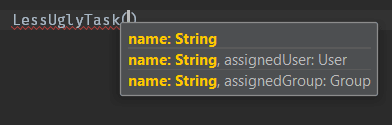
Another way is by having multiple constructors, each for every valid assignment:
This file contains hidden or bidirectional Unicode text that may be interpreted or compiled differently than what appears below. To review, open the file in an editor that reveals hidden Unicode characters.
Learn more about bidirectional Unicode characters
This implementation also puts all the logic in the task but it removes those null checks and makes it easier for the developer to understand it:
With that said, all other drawbacks in readability and scalability remain the same:
This file contains hidden or bidirectional Unicode text that may be interpreted or compiled differently than what appears below. To review, open the file in an editor that reveals hidden Unicode characters.
Learn more about bidirectional Unicode characters
The best way to implement the business logic is by using Kotlin’s sealed classes. This way we can represent our business logic straight into our code and also keep our code clean, readable and scalable:
This file contains hidden or bidirectional Unicode text that may be interpreted or compiled differently than what appears below. To review, open the file in an editor that reveals hidden Unicode characters.
Learn more about bidirectional Unicode characters
Now, printAssignment() leverages all of Kotlin’s powers, including smart cast, making it easier to the eye:
This file contains hidden or bidirectional Unicode text that may be interpreted or compiled differently than what appears below. To review, open the file in an editor that reveals hidden Unicode characters.
Learn more about bidirectional Unicode characters
and the rest of the code does not need any extra help like named arguments:
This file contains hidden or bidirectional Unicode text that may be interpreted or compiled differently than what appears below. To review, open the file in an editor that reveals hidden Unicode characters.
Learn more about bidirectional Unicode characters

 le0nidas